

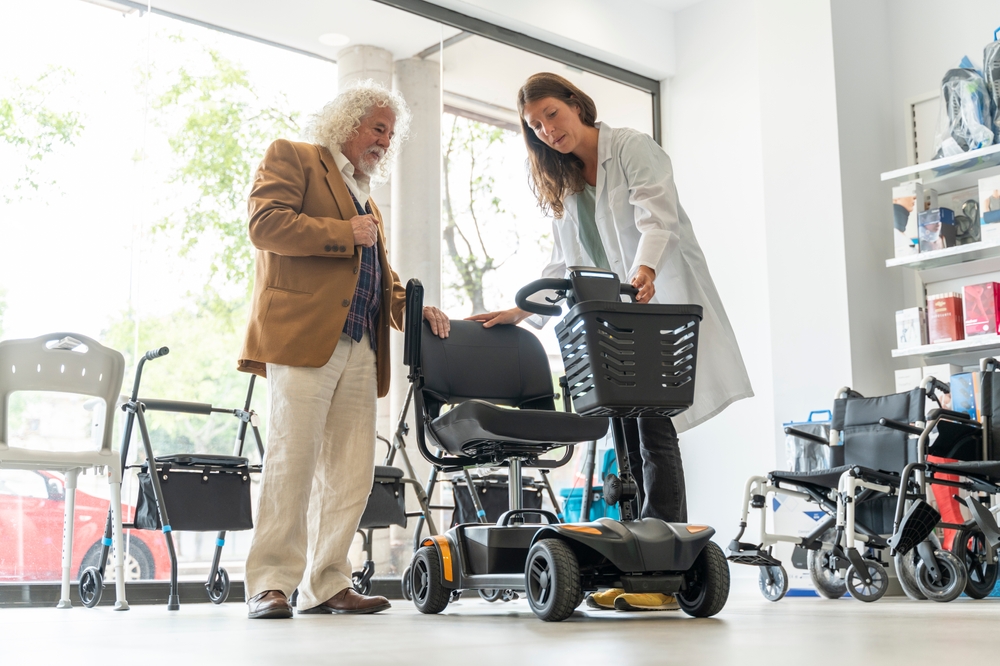
From the rolling terrain near the Susquehanna River to the uneven sidewalks throughout downtown, choosing the right motorized mobility device is not just a matter of comfort. It is a matter of safety. The debate over power wheelchair vs. mobility scooter safety is one that many residents, caregivers, and healthcare providers face regularly. Understanding the key differences between these two devices can help you make a smarter, safer choice for your everyday life.
The Basic Differences Between Power Wheelchairs and Mobility Scooters
Before diving into safety comparisons, it helps to understand what sets these devices apart. A power wheelchair is a fully motorized chair that is controlled with a joystick, typically mounted on the armrest. It is designed for individuals who need significant postural support and cannot self-propel a manual wheelchair. The device wraps around the user, offering head support, adjustable armrests, and custom seating systems.
A mobility scooter, on the other hand, looks more like a motor vehicle. It has a seat mounted on a platform, handlebars or a tiller for steering, and typically three or four wheels. Portable mobility scooters are especially popular because they can be disassembled and transported in a car trunk, making them a flexible option for people who are still somewhat mobile but need assistance over longer distances.
Both devices run on rechargeable batteries, but their design philosophies are quite different. Power wheelchairs are built for medical necessity and complex rehabilitation needs. Mobility scooters are often marketed toward people with mild to moderate mobility limitations who want more independence.
Navigating Binghamton Hills: Which Device Handles Terrain Better?
When it comes to finding the best mobility devices for Binghamton hills, terrain performance becomes the top priority. Binghamton is not a flat city. The South Side, West Side, and areas near Prospect Mountain feature inclines that can be genuinely hazardous for the wrong device.
Power wheelchairs generally perform better on steep or uneven terrain. They have a lower center of gravity, four-wheel drive in many models, and a compact footprint that allows for precise maneuvering. The joystick control system gives users fine-tuned speed and directional adjustments, which matters greatly when navigating curb cuts, cracked pavement, or grassy paths near Recreational Park or Otsiningo Park.
Mobility scooters, particularly three-wheeled versions, can struggle on hills and uneven surfaces. The tiller steering mechanism requires more physical effort to control, and the higher seat position raises the center of gravity. This increases the risk of tipping, especially during sharp turns on sloped ground. Four-wheeled scooters offer better stability than three-wheeled models, but they still fall short compared to power wheelchairs when the terrain gets demanding.
For Binghamton residents who frequently travel along the Riverwalk, cross busy intersections near Court Street, or navigate the hilly neighborhoods on the city’s periphery, a power wheelchair offers a measurable safety advantage in most outdoor conditions.
Electric Wheelchair Turning Radius and Indoor Safety
One of the most overlooked aspects of power wheelchair vs. mobility scooter safety is how each device performs indoors. The electric wheelchair turning radius is a critical factor, particularly in older Binghamton homes, small apartments, and local businesses that may not have been built with generous accessibility in mind.
Power wheelchairs come in several configurations. Rear-wheel drive models offer a larger turning radius but more stability at higher speeds. Mid-wheel drive power wheelchairs are the most popular for indoor use because they can turn almost in place, making them ideal for tight hallways, small bathrooms, and crowded spaces. Front-wheel drive models handle obstacles well and perform reliably on uneven terrain.
Mobility scooters require a significantly larger turning radius. Most scooters need at least 60 inches of clear space to execute a full turn. That kind of clearance simply does not exist in many older buildings and homes throughout the Binghamton area. Navigating around furniture, doorways, or crowded store aisles can become frustrating or even dangerous if the device cannot maneuver efficiently.
If a significant portion of your daily use involves indoor spaces, such as medical offices, grocery stores, or your own home, a power wheelchair with a mid-wheel drive design will almost always be the safer and more practical choice.
Portable Mobility Scooters: Convenience vs. Safety Trade-offs
There is no denying that portable mobility scooters have a real advantage when it comes to travel and convenience. Many models can be broken down into pieces weighing as little as 15 to 30 pounds each, making them easy to load into a standard vehicle. For Binghamton residents who visit family outside the area, use public transit, or take road trips, this portability is a genuine benefit.
However, portability often comes at a cost to safety features. Lightweight scooters typically have narrower wheelbases, smaller motors, and less robust suspension systems. They may not handle Binghamton winters particularly well either. Snow, ice, and slush on city sidewalks can be treacherous on a lightweight scooter with small wheels and limited traction.
Power wheelchairs are generally heavier and less portable, but that weight serves a purpose. It contributes to stability, especially on rough or slippery surfaces. Some power chairs are compatible with vehicle lifts and ramps, and certain compact models can fit in larger SUVs or vans with modifications. For users whose primary concern is daily safety in and around Binghamton, portability should not be the deciding factor.
That said, for someone with strong upper body function who only uses a device occasionally for longer community outings, a four-wheeled portable mobility scooter may offer a reasonable balance of convenience and safety. The key is matching the device to your actual lifestyle and the specific environments you encounter most often.
Conclusion
Choosing between a power wheelchair and a mobility scooter is a personal decision, but safety should always lead the conversation. For most Binghamton, NY residents navigating hills, older infrastructure, tight indoor spaces, and unpredictable weather, a power wheelchair offers a stronger overall safety profile. The superior turning radius, lower center of gravity, and customizable seating make it the more reliable choice for daily use across varied terrain.
Mobility scooters remain a solid option for users with moderate mobility needs who prioritize portability and occasional community outings. Portable mobility scooters in NY are widely available through local durable medical equipment providers, and many are covered in part by Medicare or Medicaid with a qualifying prescription.
No matter which device you choose, always consult with a physical or occupational therapist who can assess your specific needs. A proper fitting and training session can make an enormous difference in how safely and confidently you use your device throughout Binghamton and beyond.
Need Home Medical Equipment In Binghamton, NY?
Penn York Medical is a local healthcare medical equipment shop located in Binghamton, New York since 1957. For over 44 years, we have been selling a wide selection of healthcare products, along with installing and repairing our equipment to ensure you’re always getting the best. We offer walkers, wheelchairs, hospital beds, vehicle mobility assistants, scooters, stairway lifts, motorized wheelchairs, lift chairs, and much more! Call us today and let us find an affordable solution for your home medical needs.